

When a large earthquake strikes a city, the outcome is largely decided before the first tremor. It is decided by how buildings were designed and retrofitted years earlier, and by whether people and systems get a few seconds of warning. Neither is enough alone. This article sets out how engineering and early warning work together, and what city authorities and enterprise risk teams can do to strengthen both.
Why cities are so exposed
Cities concentrate people, older building stock, lifelines and economic activity in a small area. Damage is rarely uniform. Soft soils amplify shaking, reclaimed land can liquefy, and a handful of vulnerable building types account for a large share of casualties: unreinforced masonry, non-ductile concrete frames and buildings with a weak ground storey.
Secondary effects often compound the problem. Gas leaks start fires, water mains break just when firefighters need them, and damaged bridges cut access for emergency crews. Planning for an earthquake therefore means planning for the failure of several connected systems at once.
Engineering that keeps buildings standing
Design for ductility, not just strength
Modern seismic codes aim to let a building bend and dissipate energy without collapsing. Ductile detailing in reinforced concrete, closely spaced ties in columns, and strong-column, weak-beam design all help a structure deform without sudden failure. The goal in a major event is life safety, with the best-performing buildings also remaining usable afterwards.
Base isolation and energy dissipation
Base isolation places flexible bearings between a building and its foundation so that the ground can move while the structure above moves far less. Dampers, which absorb energy in the way shock absorbers do in a car, reduce sway in tall buildings. These systems cost more at the design stage, which is why they are most often used for hospitals, data centres, emergency operations centres and other facilities that must keep working.
Retrofitting what already exists
Most of the buildings that will face the next earthquake have already been built. Retrofit programmes target the worst performers first: strengthening soft-storey buildings with steel frames or shear walls, tying masonry walls to floors and roofs, and securing parapets and facades that fall onto streets. A tiered approach works well, starting with schools, hospitals and high-occupancy buildings, then moving to housing.
Early warning: using the seconds you have
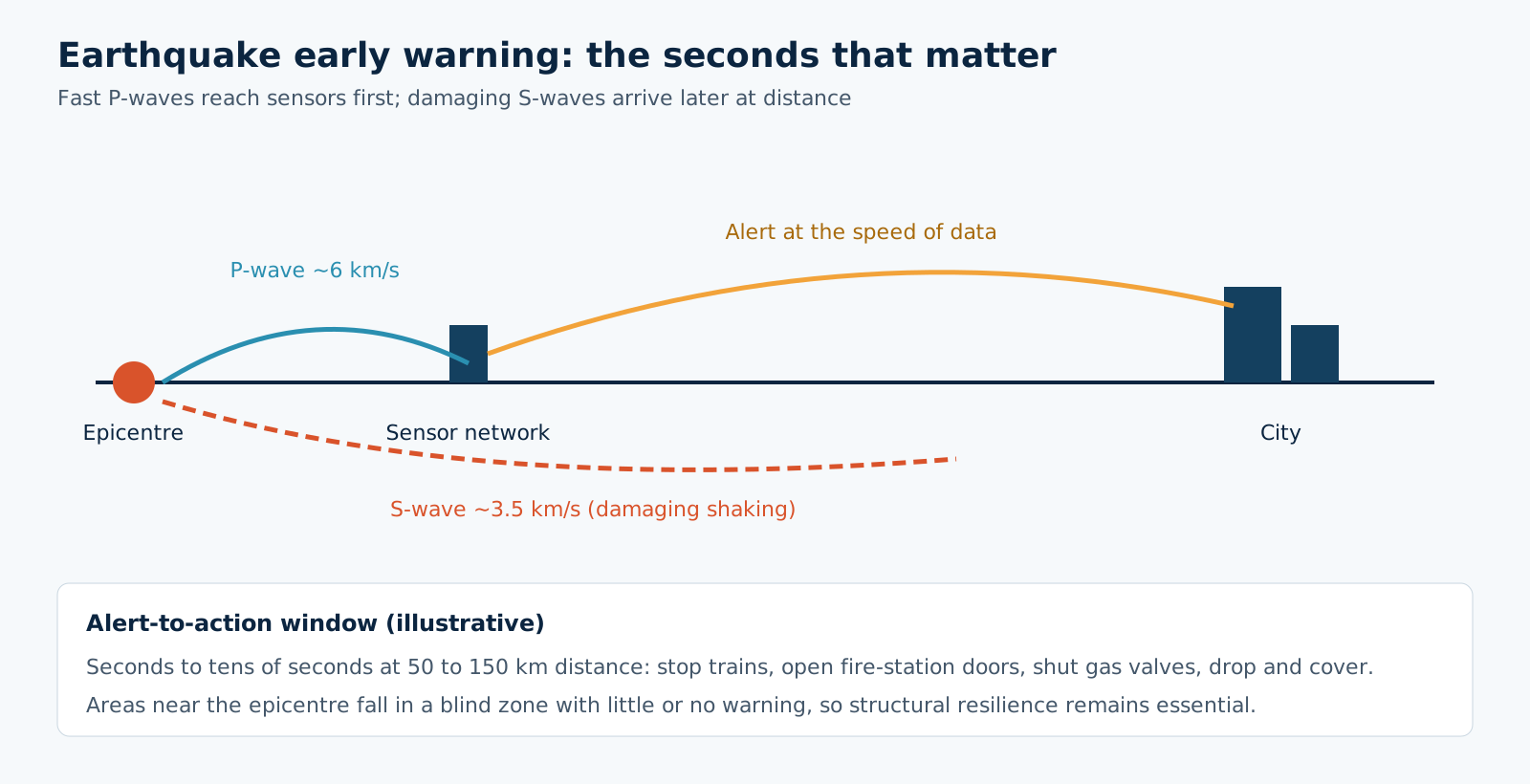
Earthquake early warning systems detect the first, faster P-waves close to the epicentre and send alerts ahead of the slower S-waves that cause most damage. The warning time depends on distance. Far from the source it can be tens of seconds; close to it, there may be none at all. Japan, Mexico, Taiwan and the western United States (through the ShakeAlert system) all operate public alerting of this kind.
A few seconds is only useful if something is prepared to act on it. The strongest programmes connect alerts to automatic or rehearsed actions:
- Slowing or stopping trains and metro services.
- Opening fire-station doors and moving apparatus out before shaking starts.
- Shutting gas and water valves, and putting industrial processes into a safe state.
- Stopping lifts at the nearest floor and opening the doors.
- Pausing surgery or sensitive equipment in hospitals and laboratories.
- Pushing alerts to phones and public address systems so people can drop, cover and hold on.
Organisations should be honest about the limits. Alerts can be late or missed in the area nearest the epicentre, and a false alarm has a real cost. Systems need regular testing, clear public messaging and drills so that people respond calmly and correctly.
Closing the gap: from technology to city operations
Integrate warning with lifeline operators
Utilities, transport operators and hospitals should be formally connected to alert feeds, with written agreements on what each will do and who authorises it. Test these links at least once a year, including what happens if the primary data feed fails.
Use shaking data after the event
Dense sensor networks are valuable after the earthquake as well. Rapid shake maps and structural health monitoring on key buildings and bridges help emergency managers decide where to send inspection teams and which structures to close. That speeds up the first 24 hours, when decisions are made with very little information.
Plan for the blind zone and the aftershocks
Because people near the epicentre may receive little warning, building safety remains the main defence there. Aftershocks can bring down weakened buildings, so rapid damage assessment, clear tagging of unsafe structures and safe holding areas are part of the plan, not an afterthought.
What enterprise risk teams can do now
- Identify which sites sit on soft soil, near faults or in older buildings, and rank them by the critical services they support.
- Commission a structural assessment for those sites and cost the retrofit options against likely downtime.
- Anchor heavy equipment, racks, tanks and ceilings; non-structural damage causes much of the loss in moderate earthquakes.
- Subscribe to official early warning where available and define what staff and systems do on receipt.
- Run a drill each year that includes an unannounced alert, a blocked exit and a loss of power.
- Keep backups and recovery sites outside the same fault zone and power grid.
Key takeaways for practitioners
- Building performance decides casualties; early warning improves the odds but does not replace sound structures.
- Prioritise retrofits for schools, hospitals and high-occupancy buildings, and the weak-storey and masonry types that fail first.
- Consider base isolation and dampers for facilities that must keep operating after a major quake.
- Early warning only helps when alerts are tied to rehearsed or automatic actions.
- Be open about blind zones and false alarms, and keep testing and training.
- Connect lifeline operators to alert feeds with clear authorities and annual tests.
- Use sensor data after the event to direct inspections and decisions in the first day.
The next article in this series turns to flash floods, where hydrological monitoring and evacuation protocols face a similar race against the clock.